
About the podcast
Climate Science Is Complicated. Understanding It Shouldn’t Have to Be.
The Climate Translation is a podcast about understanding how our changing climate actually works. Hosted by meteorologist and educator Dr. Mac, the show takes climate science out of journal articles, technical reports, political arguments, and dramatic headlines and translates it into language that makes sense to people who may never have taken an atmospheric science course.
Each episode begins with a question, an observation, a new piece of research, or something happening in the world around us. From there, the goal is not simply to tell listeners what scientists are finding, but to explain why it is happening.
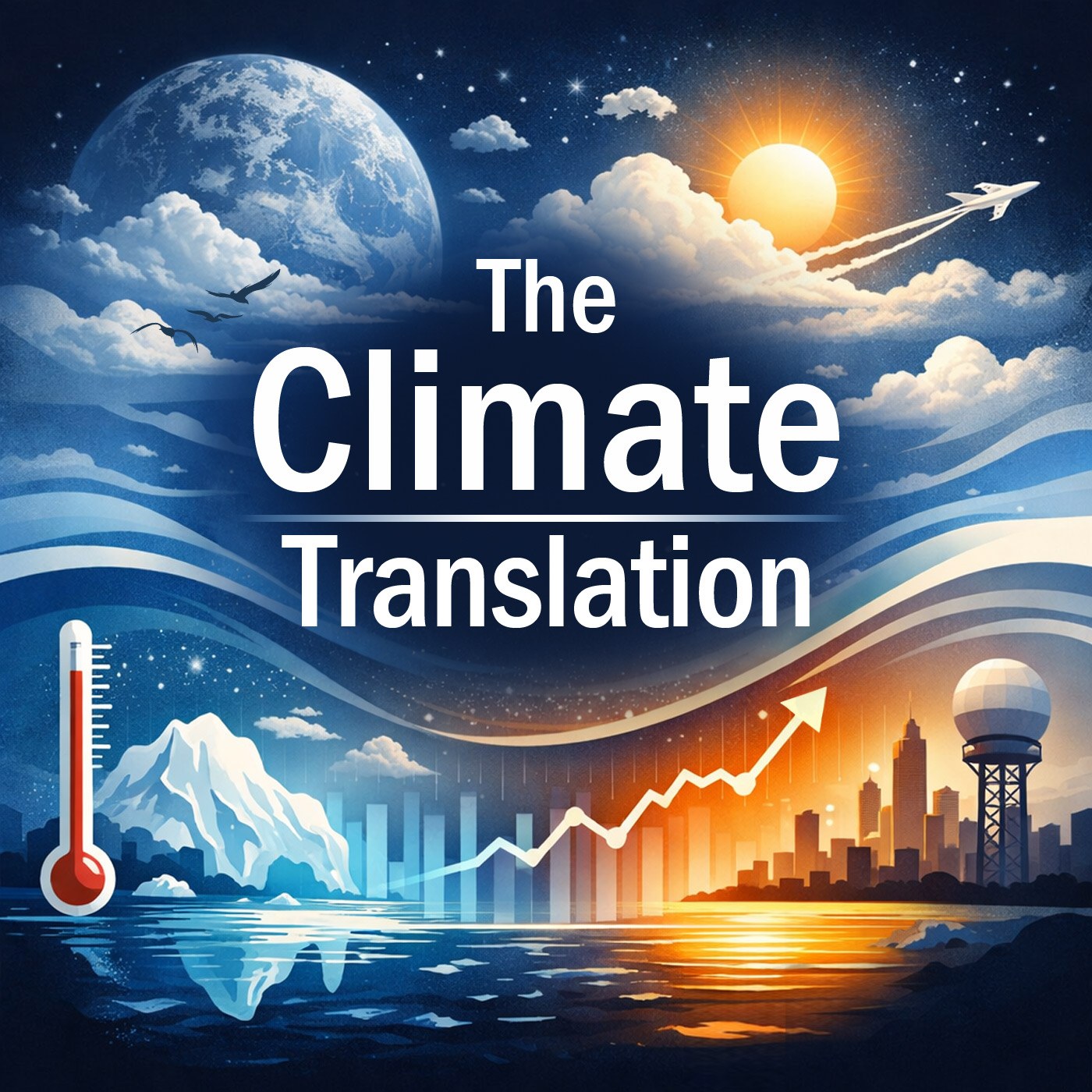
What does a warming ocean actually do to a hurricane? Why can a city become dramatically hotter than the countryside around it? What does a “100-year flood” really mean? Why can cleaning the atmosphere reveal warming that was already there? How can something as familiar as a sea breeze, a hailstorm, a tree, or a patch of shade tell us something about a changing climate?
The answers usually begin with physics, chemistry, biology, or Earth science, but the real work of The Climate Translation is making those connections understandable. That has been the purpose of the show from the beginning: strip away the jargon without stripping away the science.

Where the Story Began
The roots go back much farther than the podcast itself.
The roots of The Climate Translation go back much farther than the podcast itself. In the opening minutes of the first episode, Dr. Mac tells a story from 1994, when he was sitting behind the console of a college radio station interviewing the director of a relatively new Broadcast Meteorology program. It was an interesting moment in the history of weather communication. Television meteorology was changing, and increasingly, the person presenting the weather was expected not simply to be a broadcaster, but someone educated in atmospheric science and trained to explain that science to the public.
At the same time, climate change occupied a very different place in public conversation. In that college radio studio, it was still largely the kind of subject encountered in a textbook. Over the following three decades, it would become one of the most widely discussed (and politically charged) scientific issues in the world.
Dr. Mac eventually spent his own career moving between those same worlds: meteorology, broadcasting, education, and science communication. He worked as a television meteorologist in South Texas, taught undergraduate Earth science and meteorology, and communicated science to public audiences along the Gulf Coast. Through all of those experiences, the same problem kept appearing: knowing the science and communicating the science are not the same thing.
The Translation Problem
Data matters. But people experience the world through observations and stories.
Climate science produces an enormous amount of information: parts per million, global mean temperatures, radiative forcing, ocean heat content, gigatons of ice loss, return intervals, and atmospheric circulation. Those terms are useful (and often necessary) among scientists, but most people do not experience the world as a collection of measurements.
We experience weather when we walk outside. We notice whether summers seem different from the ones we remember. We watch a reservoir fall, a storm strengthen, a river rise, or smoke drift across the sky. We experience the world through observations and stories.
That disconnect became one of the central ideas behind The Climate Translation. As Dr. Mac explained in Episode 1, people live in a world overflowing with climate data, headlines, commentary, yet much of it fails to connect to everyday experience. The answer is not to remove the science; it is to translate it.
Not a Debate Show
Skepticism is not the enemy of science.
The Climate Translation was also created around another principle: skepticism is not the enemy of science. In the classroom, Dr. Mac encourages students to question what they hear, and that includes what they hear from him. The goal is not agreement for the sake of agreement; it is learning how to ask better questions and how to look for answers grounded in evidence rather than hyperbole.
That philosophy shapes the podcast. Climate science has become entangled with politics, identity, media, and culture, and conversations about it can quickly become arguments between competing sides. This show takes a different approach:
When uncertainty exists, we talk about the uncertainty.
When scientists disagree about a mechanism or the size of an effect, we talk about what is still being studied.
When the evidence is strong, we explain why scientists consider it strong.
When a headline exaggerates what a study actually found, we slow down and look at the research itself.
The goal is not to win an argument; it is to understand the system. As Dr. Mac put it in the first episode, the goal is to stop shouting across the gap between “the experts” and “the rest of us” and instead build a bridge between them.
How the Show Has Evolved
From foundational questions to the connections throughout the Earth system.
The earliest episodes of The Climate Translation tackled some of the foundational questions surrounding climate science and climate communication: scientific consensus, climate evidence, skepticism, the rate of change, and how scientists reconstruct Earth's climate history. As the show developed, its scope widened. Episodes began exploring individual pieces of the Earth system: glaciers, oceans, forests, aerosols, hurricanes, the jet stream, sea breezes, freshwater, urban heat, biodiversity, hail, flooding, and other places where climate interacts with the world people experience every day.
Research increasingly became part of those stories as well. Rather than simply saying that “scientists have found” something, the podcast identifies the researchers, institutions, locations, observations, and methods behind important studies whenever possible. That distinction matters. Science is not a collection of anonymous facts; it is a process carried out by people who measure things, test ideas, compare results, challenge conclusions, and gradually improve our understanding of how the planet works. And sometimes the most interesting climate stories are not about what scientists already know, but about what they are still trying to figure out.

A Podcast About Connections
Earth does not operate as a collection of isolated pieces.
One theme has emerged again and again throughout The Climate Translation: Earth does not operate as a collection of isolated pieces. The atmosphere interacts with the ocean, the ocean interacts with ice, ice affects freshwater, forests exchange carbon and water with the atmosphere, and cities change the way heat is stored. Changes in temperature influence circulation, rainfall, ecosystems, infrastructure, and hazards.
Understanding climate means understanding those connections. That is why an episode might begin with something as small as a hailstone or a city tree and eventually lead into a much larger discussion about atmospheric physics, infrastructure, risk, or adaptation. The subject changes from episode to episode, but the approach does not: start with something familiar, follow the science, explain the mechanism, acknowledge what we do not know, and connect it back to the world outside the window.
Curiosity Before Conclusions
Science asks us to be curious.
Perhaps the simplest statement of what The Climate Translation is trying to accomplish appeared in its very first episode: science is not something we are asked to “believe” in; science asks us to be curious.
That curiosity remains at the center of the podcast. You do not need a degree in meteorology to understand why the atmosphere behaves the way it does. You do not need to memorize every climate statistic, and you do not need to arrive already knowing what you think about every issue. You only need to be willing to ask the next question.
Because the goal of The Climate Translation has never been to tell listeners what to think. It is to give them enough understanding to think about the climate more clearly for themselves.
The Climate Translation
Follow the science.
Understand the mechanism.
Make the connection.
Hosted by Dr. Mac.
Questions, comments, or a different point of view are welcome at TheClimateTranslation@gmail.com.